Assistant Professor Department of Pharmaceutical, Social and Administrative Sciences Samford University Birmingham, Alabama, United States
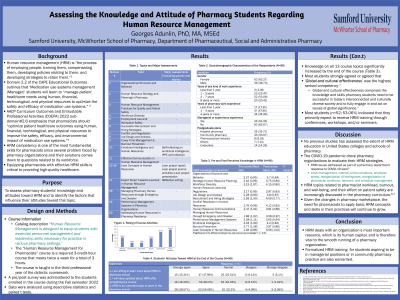
Objective : To assess pharmacy students’ knowledge of human resource management (HRM) as well as their attitudes toward the education they received in a didactic HRM Course.
Methods: A survey of third-year students enrolled in an HRM course was conducted in the fall of 2022. Participants were asked to rate on a 5-point scale their pre- and post-course knowledge of 13 HRM topics, and to rank the relative importance of a list of 8 HRM competencies for pharmacy graduates entering the workforce. Descriptive statistics and measures of associations were used to analyze the data.
Results: All the students (n=98) enrolled in the course completed the survey. The student's knowledge of the HRM topics increased between pre- and post-survey measurements and were all statistically significant (p < 0.00). While most of the increases in HRM were slightly moderate, increases in knowledge were considerable on emotional intelligence, workforce diversity, conflict resolution, and recruitment and hiring strategies. Overall attitudes toward HRM were positive. Out of all the learning activities the majority of students (71%) indicated that the expert panel session helped enhance their knowledge the most. Participants placed higher importance on the competency for ‘Global and Cultural Effectiveness—The ability to value and consider the perspectives and backgrounds of all parties’.
Conclusions: HRM competency should be one of the most fundamental skills for pharmacists since every problem faced by pharmacy organizations and their solutions comes down to questions related to its workforce. Schools and colleges of pharmacy should assess their curriculum to ensure HRM management is adequately covered to meet the accreditation standards but also prepare graduates to deliver safe and high-quality health care.