Assistant Professor Department of Pharmaceutical, Social and Administrative Sciences Samford University Birmingham, Alabama, United States
Objective : To characterize the extent to which accredited pharmacy programs in the United States (US) have incorporated pharmacoeconomics education into the didactic and experiential curriculum of Doctor of Pharmacy (PharmD) programs.
Methods: We systematically searched all US. -based pharmacy with accredited professional degree programs curriculum websites to identify relevant pharmacoeconomics content.
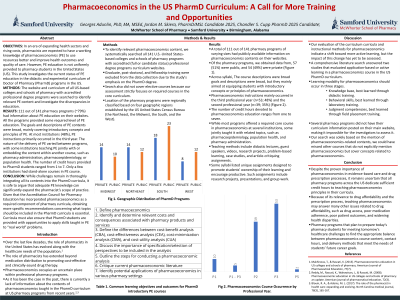
Results: A total of 111 out of 141 pharmacy programs of varying sizes had publicly available information on pharmacoeconomics contents on their websites. All the programs that were assessed had required content in pharmacoeconomics. Across syllabi, goals and descriptions were broad, aiming to equip students with introductory concepts or principles of pharmacoeconomics. The number of credit hours devoted to pharmacoeconomics education ranges from one to seven. The nature of the delivery of pharmacoeconomics content varied between programs. Some institutions taught pharmacoeconomics jointly with another course, while some covered it as a subtopic within another course.
Conclusions: Understanding the principles of pharmacoeconomics must be a core component of the PharmD curriculum to prepare pharmacists to assess the rational use of pharmacy products and services, improve clinical outcomes, and reduce healthcare costs. For this reason, pharmacy schools must evaluate their PharmD curricula to ensure that pharmacoeconomics education is appropriately integrated.