Professor and Chair, Department of Pharmaceutical and Administrative Sciences School of Pharmacy, Presbyterian College Clinton, South Carolina, United States
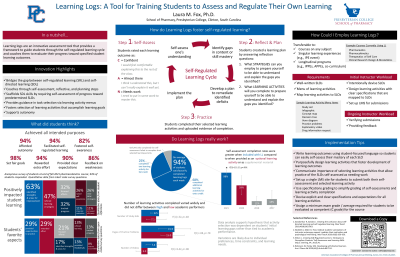
Objective : Implement a novel assessment tool, called Learning Logs (LL), to provide the framework and guidance necessary for students to gain needed skills in self-regulating their learning.
Methods: LL was incorporated into pharmacokinetics (fall 2021) to augment established learning activities and assessments (i.e., homework assignments, quizzes, in-class exercises, exams). Each week, students completed a LL by self-assessing their mastery of each student learning outcome, determining any deficits, and selecting at least one activity from a menu of optional learning activities to address self-identified gaps in the mastery of the topic. Students then submitted evidence that they completed their chosen learning activity. Each LL was graded as incomplete or complete using specifications grading. The effectiveness of LL was evaluated by examining student perceptions and completion rates.
Results: Students overwhelmingly agreed that LL achieved their purposes of affording autonomy, facilitating self-regulated learning, fostering self-awareness, and providing clear expectations, feedback, and reward for extra effort. Almost all respondents thought the goals set by LL were fair. On average, 98% of students completed the self-assessment for each topic, with the majority earning extra credit. Self-assessment completion rates were higher when incorporated as part of LL than in previous years (p <.001). Activity selection did not differ between high and low academic performers.
Conclusions: Learning logs are an effective and efficient tool for training students to assess and regulate their own learning.