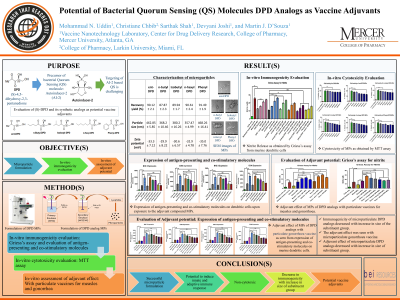
Objective : A small molecule, DPD (4,5-dihydroxy pentane-2,3-dione), is involved in bacterial communication called quorum sensing (QS). This molecule has the potential to fight against bacterial diseases. We propose to develop a microparticulate (MP) formulation of DPD synthetic analogs to assess their potential as a vaccine adjuvant
Methods: Analog MPs were formulated by a double-emulsion solvent evaporation method using PLGA polymer. The induction of innate immune response was analyzed by Griess’s assay. The ability of DPD microparticles to induce cellular and humoral adaptive immune response was evaluated in vitro by measuring the expression of antigen-presenting molecules MHC I and MHC II and their co-stimulatory molecules, CD80 and CD40, on the surface of APCs. Analogs of DPD MPs were paired with the particulate vaccines for measles and gonorrhea.
Results: All the MPs were found to be non-cytotoxic to the APCs. Analog MPs with and without classical adjuvants (Alum and MF59) showed significantly higher expression of the release of nitric oxide, MHC I, MHC II, CD80, and CD40. MP analog ent-DPD was found to have an adjuvant effect upon the combination with the gonorrhea vaccine, but not with the marketed measles vaccine. Ent-DPD analog MPs are immunogenic and can stimulate innate and adaptive immune responses. The adjuvant effect of the analogs decreased with an increase in the substituent group.
Conclusions: Microparticulate DPD and analog ent-DPD are immunogenic and can stimulate an innate and adaptive immune response. A combination of DPD with various particulate vaccines reveals that microparticulate DPD and ent-DPD show an adjuvant effect with bacterial vaccines.