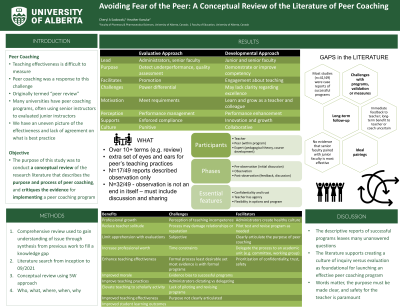
Objective : The purpose of this review was to conduct a conceptual review of the research literature that describes the purpose and process of peer coaching, and critiques the evidence for implementing a peer coaching program.
Methods: A conceptual review was selected. A librarian assisted in the literature search through ERIC, Google Scholar, Web of Science, EBSCO, ProQuest Central, Worldcat, International Bibliography of the Social Sciences, and Project MUSE. A total of 1142 documents were identified and 49 remained for inclusion after review by the authors.
Results: : The literature for peer review of professors began in the 1980’s when there were calls for measures of teaching effectiveness. Terminology has evolved to “peer coaching” as the currently accepted term. There is compelling evidence of benefit in the reciprocal relationship of coaching, creating discussion of best practices and building relationships. The peer coaching programs target primarily new or junior instructors, assigning mid-career or senior instructors to the role of coach, with little justification. There is literature critiquing peer coaching, with instructors experiencing anxiety, and concerns about the validity and reliability of the process. There were no studies that provided evidence of teaching effectiveness. A checklist and procedure were compiled from the literature to guide instructors and administrators in establishing a peer coaching program.
Conclusions: There is evidence to support peer coaching but a number of steps should be taken prior to the implementation of such a program.