Associate Dean for Academic Affairs Concordia University Wisconsin Mequon, Wisconsin, United States
Objective : To determine if use of optional enrichment improved student performance in a pharmacy law course.
Methods: The pharmacy law course was completely redesigned with objectives, organization, course content, assignments, exams, and enrichment materials newly developed to align with the Multistate Pharmacy Jurisprudence Exam (MPJE) competencies. Required course elements included 22 lectures, 22 post-lecture assignments (multiple attempts allowed prior to due dates, 213 total questions), and five exams (226 total questions). Assignments and exams followed MPJE formatting. MPJE competency-aligned optional enrichment included 466 gameshow-style “answer-in-the-form-of-a-question” practice questions. Enrichment also included the ability to repeat archived assignments after due dates. Enrichment performance and use was not part of students’ grades.
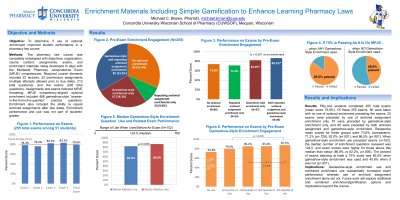
Results: Fifty-one students completed 255 total exams (mean score 79.9%). Of these 255 exams, 80 were taken with no use of optional enrichment preceding the exams, 23 exams were preceded by use of archived assignment enrichment only, 67 were preceded by gameshow-style enrichment only, and 85 were preceded by both archived assignment and gameshow-style enrichment. Respective mean scores for these groups were 73.8% (comparator), 71.2% (p=.728), 82.0% (p <.001), and 86.5% (p <.001). When gameshow-style enrichment use preceded exams (n=152), the median number of enrichment questions reviewed was 124.5, and exam scores were higher for those above this median than below (86.8% vs 82.2%, p=.005). The percent of exams attaining at least a 75% score was 85.5% when gameshow-style enrichment was used and 45.6% when it was not (p <.001).
Conclusions: Gameshow-style enrichment use and combined enrichment use substantially increased exam performance whereas use of archived assignment enrichment alone did not. Future work will explore additional and combined enrichment/gamification options and implications beyond the course.