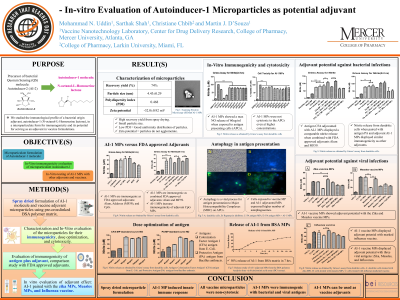
Objective : Autoinducer molecule, Autoinducer-1 (AI-) is a communicator or ‘signal’ of both gram positive and negative bacteria. Converting this compound into a microparticle allows this compound to appear foreign to the body and thus can trigger immune response. The goal of this study is to evaluate this microparticulate as potential adjuvant in vaccine formulations.
Methods: The AI-1 microparticles (MPs) were formulated by a W/O/W double-emulsion solvent evaporation method by using the PLGA (poly (lactic-co-glycolic acid) polymer. In vitro immunogenicity was observed via Griess’s assay by measuring the release of nitric oxide (NO) by dendritic cells. Adjuvant potential was evaluated by paring adjuvant AI-1 MPs with particulate vaccines for measles, zika virus, influenza, and meningococcal polysaccharide.
Results: The MP were characterized for particle size, charge, and the polydispersity index: 4.43±0.29 um, -32.0±0.92 mV, and 0.468. The low PDI indicates uniform size distribution of the particles. The negative surface charge indicates the high stability of MP in an aqueous solution. Morphologically, the particles were found to be spherical. NO release was found to be higher of CFA antigen and AI-1 adjuvant verses the antigen alone. MPs were found to be non-cytotoxic to the dendritic cells. Encapsulation efficiency ranged from 51-70%.
Conclusions: The microparticulate formulations of AI-1 and all other MPs are non-cytotoxic towards the dendritic cells. AI-1 is immunogenic as the FDA approved adjuvants such as Alum, MF59, and CpG. Adjutancy potential was seen when AI-1 was paired with several particulate vaccines indicating that AI-1 can be used for both bacterial and viral infections.