Associate Dean for Academic Affairs Concordia University Wisconsin Mequon, Wisconsin, United States
Objective : To map federal and state pharmacy laws to Multistate Pharmacy Jurisprudence Exam (MPJE) competencies as a tool to inform development of content and assessment in a pharmacy law course.
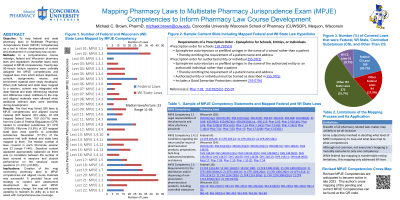
Methods: In a comprehensive course redesign, federal and Wisconsin pharmacy laws and regulations (hereafter laws) were mapped to MPJE competencies. Twenty-two 50-minute lecture sessions were ordinally assigned the MPJE competencies and mapped laws, from which lecture objectives, content, assignments, exams, and enrichment material were newly developed. When both federal and state laws mapped to a session, content was integrated with clear federal and state referencing retained and differences noted. Additions to the map and aligned materials were allowed when additional relevant laws were identified during development.
Results: The final map linked 526 laws to MPJE competencies and aligned course material (203 federal, 323 state). Of 203 mapped federal laws, 109 (53.7%) were from the Code of Federal Regulations (CFR) related to controlled substances (21 CFR 1300-99). Fifty-one (15.8%) of 323 mapped state laws were specific to controlled substances. Seventeen (77.3%) of the sessions had both federal and state laws mapped to them. The median number of laws covered in each 50-minute session was 23 (range 11-46). Sessions’ content appeared appropriately balanced as there was no correlation between the number of laws covered in sessions and student performance on the sessions’ exam questions (r=-.012, p=0.683).
Conclusions: Creation of the map connecting pharmacy laws to MPJE competencies and aligned course materials was successful. It provided focus and strategy to content and assessment development. As laws and MPJE competencies change, the map will require updating to maintain its utility as a tool to assist with comprehensive law coverage.