Associate Dean Raabe College of Pharmacy, Ohio Northern University Ada, Ohio, United States
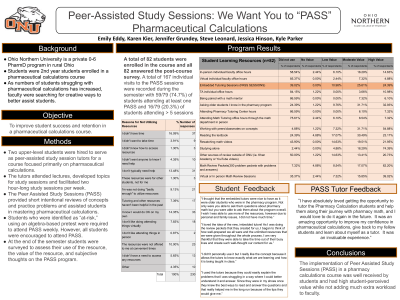
Objective : To improve student success, and retention, in a pharmaceutical calculations course.
Methods: Two upper-level students were hired to serve as peer-assisted study session tutors for a course focused primarily on pharmaceutical calculations. The tutors attended lectures, developed topics for study sessions and facilitated two hour-long study sessions per week. The Peer Assisted Study Sessions (PASS) provided short intentional reviews of concepts and practice problems and assisted students in mastering pharmaceutical calculations. Students who were identified as “at-risk,” using an algebra-based pretest were required to attend PASS weekly. However, all students were encouraged to attend PASS. At the end of the semester students were surveyed to assess their use of the resource, the value of the resource, and subjective thoughts on the PASS program.
Results: A total of 79 students were enrolled in the course and all 79 answered the post-course survey. A total of 167 individual visits to the PASS sessions were recorded during the semester with 59/79 (74.7%) of students attending at least one PASS and 16/79 (20.3%) of students attending > 5 sessions. When students were asked about the value of the PASS to their learning, 64/79 (81%) rated it as moderate or high value. When asked to reflect on what would have helped them learn better in the course, 34/79 (43%) students indicated that they should have more frequently attended PASS.
Conclusions: The implementation of Peer Assisted Study Sessions (PASS) in a pharmacy calculations course was well received by students and had high student-perceived value while not adding extra workload to faculty.