Assistant Professor University of Maryland Baltimore, Maryland, United States
Objective : Individual readiness assurance tests (iRATs) are frequently graded in team-based learning (TBL) classrooms, with the goal of incentivizing pre-class preparation. The objective of this study is to determine whether shifting to an ungraded iRAT process affects student preparation and learning, as measured using assessment scores.
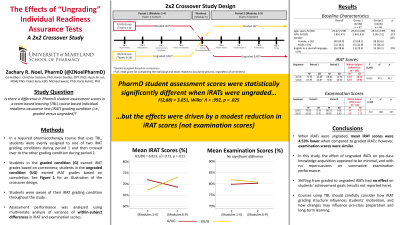
Methods: Using a 2x2 crossover design in a second-year pharmacotherapy course, students were assigned to one of two iRAT grading sequences: graded/ungraded (G/UG) or ungraded/graded (UG/G). In the G condition iRATs were graded based on correctness and in the UG condition based on completion. Students were aware of the iRAT grading condition before entering each study period. Each period consisted of four iRATs, four team readiness assurance tests (tRATs), and one examination. Repeated measures multivariate analysis of variance was used to test within-subject differences of mean iRAT, tRAT, and examination scores across grading conditions. Bonferroni correction was used for post-hoc testing.
Results: All 91 students in the course were included in the analysis. There was a statistically significant main effect for iRAT grading condition on assessment scores, F(2,88) = 3.851, Wilk's Λ = .992, p = .025. Univariate analysis demonstrated a significant difference only in iRAT scores, with the mean score higher in the G condition (72.51% versus 67.99%; p = .011). Examination scores (81.07% versus 80.32%, p = .397) and tRAT scores (96.5% versus 96.5%, p = .867) were similar in the G and UG conditions.
Conclusions: Students demonstrated a modest reduction in iRAT scores when it was "ungraded"; however, tRAT and examination scores remained markedly similar, suggesting that overall learning was similar irrespective of iRAT grading condition.