Associate Professor University of Minnesota College of Pharmacy Rosemount, Minnesota, United States
Objective : The use of a pre-class individual readiness assessment for a Team Based Learning course is an innovative pedagogical strategy and was implemented to enhance inclusivity in the use of Team Based Learning. It was expected that students would feel equally prepared for in-class application activities and that it would reduce stress for learners.
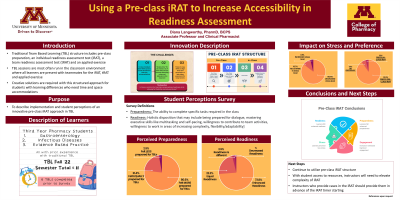
Methods: Team Based Learning (TBL) involves the use of pre-class preparation, readiness assurance, and application activities to allow learners to apply their foundational knowledge to significant problems in their discipline. The traditional structure includes an in-class closed book individual readiness assessment test (iRAT), an in-class closed book team readiness assessment test (tRAT) and an in-class open book Applied Exercise. This limits the accessibility of this strategy and instructors are not able to grant varying time limits to students with time and space accommodation needs. In a 15-week Evidence Based Practice course, a pre-class, asynchronous iRAT was implemented to increase accessibility and allow for discrete provision of time and space accommodations. Students were surveyed at the midpoint of the semester to assess perceptions of readiness, preparedness, and stress.
Results: A total of 103 out of 114 students responded to the survey (90.3%). The majority of students felt more prepared for in-class TBLs (80.3%), felt their readiness was enhanced (73.8%), and felt it decreased their stress level (85.4%). Over 90% of students responded that they prefer the pre-class iRAT over the traditional in-class iRAT structure. Engagement during in-class activities remained high.
Conclusions: The use of a pre-class iRAT allowed for enhanced inclusive design for learners and was well received by most students.