Clinical Professor University of Missouri - Kansas City, Missouri, United States
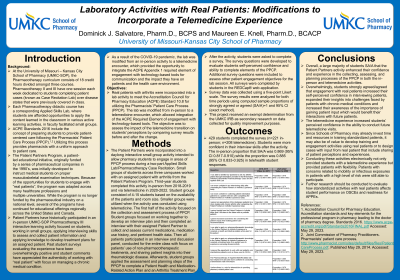
Objective : Real patients with arthritis were incorporated into a lab activity to meet the Accreditation Council for Pharmacy Education (ACPE) Standard 10.8 for utilizing the Pharmacists’ Patient Care Process (PPCP). The lab was modified from in-person to a telemedicine encounter, which allowed integration of the ACPE Required Element of engagement with technology-based tools. The objective was to assess the impact of the telemedicine transition on students' perceptions by comparing survey results before and after the change.
Methods: Third-year students completed this activity in-person from 2018-2019 and via telemedicine in 2020-2022. Survey data was collected using a five-point Likert scale. The survey results were analyzed for both time periods using computed sample proportions of strongly agreed or agreed (SA/A)=1 and 95% CI (exact method).
Results: 429 students completed the survey (n=221 in-person; n=208 telemedicine). Students were more confident in their interview skills after the activity. The in-person proportion that SA/A was 0.869 (95% CI 0.817-0.910), while the proportion was 0.885 (95% CI 0.833-0.925) in telemedicine student responses. The proportion that SA/A that this activity allowed them to apply their pharmacotherapeutic knowledge to complete a treatment plan was 0.919 (95% CI 0.874-0.951) for in-person responses and 0.938 (95% CI 0.896-0.966) for telemedicine responses. Of student respondents who completed the telemedicine activity, the proportion that SA/A that this activity helped their confidence in conducting a telemedicine visit was 0.885 (95% CI 0.833-0.925).
Conclusions: Overall, a large majority of students SA/A that the Patient Partners activity enhanced their confidence and experience in the collecting, assessing, and planning processes of the PPCP in both the in-person and telemedicine activities. The telemedicine experience increased confidence in the ability to conduct future telemedicine visits.