Professor of Pharmacy Practice University of Findlay, United States
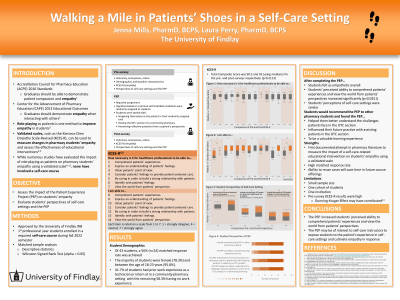
Objective : Previous studies have evaluated the impact of simulated patient experiences on students’ empathy, but none in self-care pharmacy courses have utilized a validated scale. This study assessed the impact of the Patient Experience Project (PEP) on students’ empathy and evaluated students’ perspectives of self-care settings and the PEP. We hypothesized there would be no difference in students’ empathy after the PEP.
Methods: In an established self-care pharmacy course, the PEP required students to visit the over-the-counter (OTC) section of a community pharmacy, imagine themselves as a patient, and answer reflective questions. During fall 2022, students completed pre- and post-PEP surveys to measure empathy and perspectives of self-care settings and the PEP. Empathy was measured using the validated Kiersma-Chen Empathy Scale-Revised (KCES-R). To achieve a matched sample, students designated a unique identifier on their pre-/post-surveys. Data was analyzed using descriptive statistics and the Wilcoxon Signed Rank Test (alpha=0.05).
Results: Of 43 students, a 56% matched response rate was achieved. Students felt as empathetic overall after the PEP (KCES-R composite score p>.05), though their perceived ability to comprehend patients’ experiences and view the world from patients’ perspectives increased (p=.0251, p=.0251). Students’ perspectives of OTC product quantity and ease of locating and selecting a product were similar after the PEP (all p>.05). Students indicated the PEP was a valuable experience that would influence their future practice (median 6.0 and 6.5 on a scale from 1-7, respectively).
Conclusions: While the PEP didn’t make a significant difference on students’ empathy, it increased students’ perceived ability to comprehend patients’ experiences and view the world from patients’ perspectives. The PEP represents a viable simulation activity for students to experience self-care from a patient’s perspective.

.jpg "Jenna Mills, PharmD, BCPS photo")