Associate Professor of Pharmacy Practice University of Findlay Findlay, Ohio, United States
Objective : To determine if a new assessment strategy for drug information monographs would be helpful to improve student satisfaction and learning. Null hypothesis: There will be no difference in student satisfaction and perceptions with an ungrading approach compared to traditional grading.
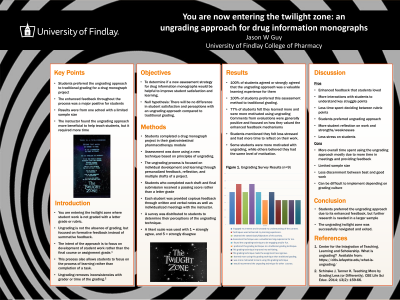
Methods: Students completed a drug monograph project and were assessed using a new technique called ungrading. The ungrading process is focused on individual development and learning through personalized feedback, reflection, and multiple drafts of a project. Students who completed each draft and final submission received a passing score rather than a letter grade and were provided copious feedback through written and verbal notes as well as individualized meetings with the instructor. A survey was then distributed to students to determine their perceptions of the ungrading technique.
Results: Of the students surveyed 100% agreed or strongly agreed that the ungrading approach was a valuable learning experience for them, and 100% of students preferred this assessment method to traditional grading. In addition, 77% of students felt they learned more and were more motivated to learn using the ungrading method compared to traditional grading. Comments were generally positive and several statements focused on how they valued the enhanced feedback mechanisms from their professor. Students also mentioned they felt less stressed and had more time to reflect on their work. There were conflicting comments regarding motivation with some students stating they were more motivated with the ungrading approach, while others believed they had the same level of motivation.
Conclusions: Students preferred the ungrading assessment method versus traditional grading. Enhanced feedback and opportunities for reflection were key benefits of the ungrading process.